The Story
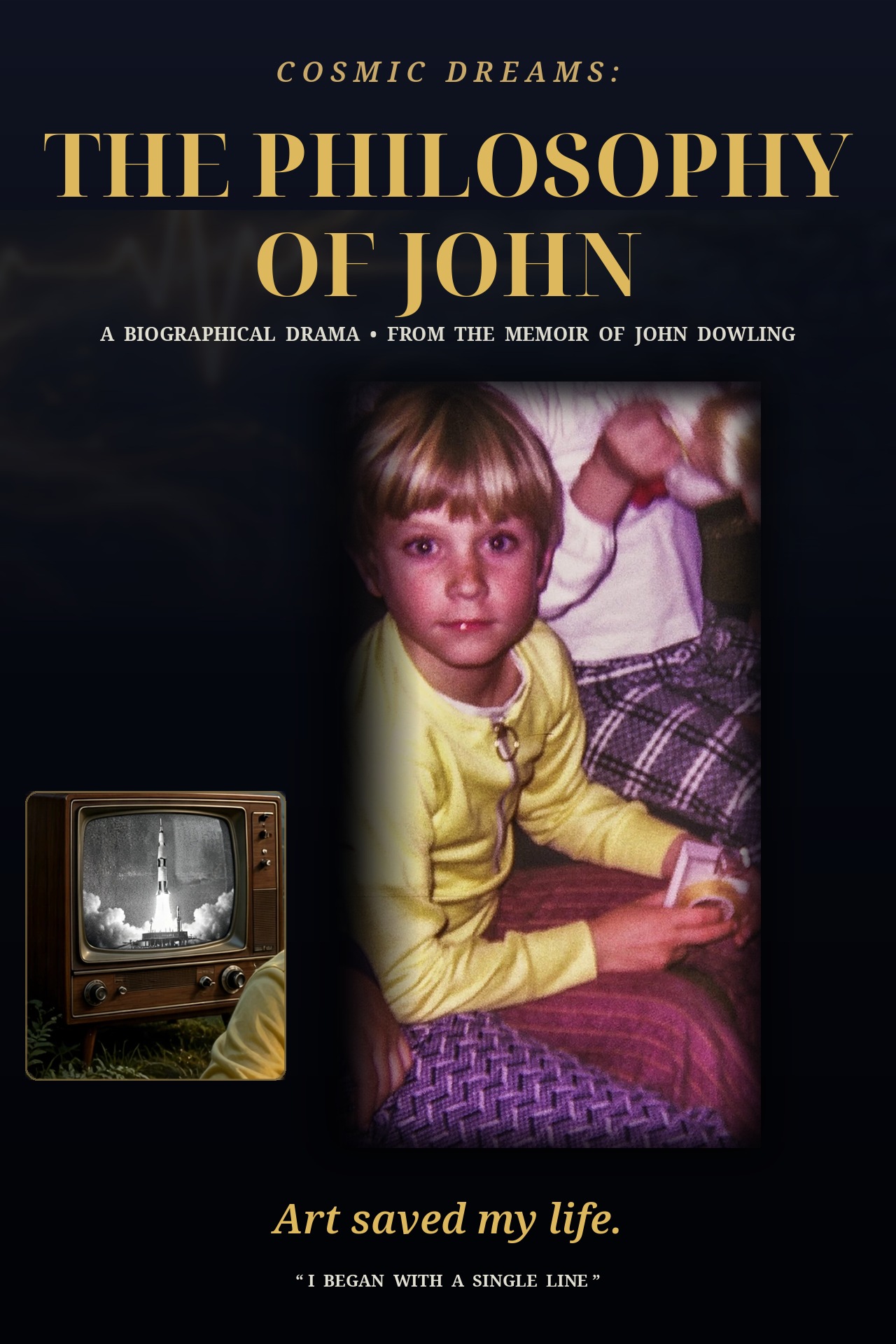
COSMIC DREAM WORLDS: THE PHILOSOPHY OF JOHN — Expanded Synopsis
Format: Feature film · Film Three of the Cosmic Dream Worlds trilogy — the prequel
Status: Script
Genre: Biographical drama
Adapted from: the book The Philosophy of John by John Joseph Dowling Jr.
Logline
Before the collection, before the ship, before Cosmic Dream Worlds, there was a four-year-old boy behind a garage, shaking in the dark — and a cheap blue pen that taught him the act that would save his life a dozen times over: draw the line, scratch through the black, frame the feeling, and stay. The Philosophy of John is the prequel to the Cosmic Dreams films: the story of John Dowling's younger life, adapted from his own book — the nightmares and the first line, the teachers who framed him, the camera and the city, the Palladium and the fifty-thousand-dollar night, the cocaine and the underside of light, the walking away, the heart that betrayed him, the walking that rebuilt him — and the philosophy it all produced: art is not decoration. Art is survival technology. Art saved my life.
The story
A four-year-old boy behind a garage, shown fat green tomato worms by his father, begins waking screaming from dreams of monsters the length of buses — and survives them when someone puts a cheap blue pen in his hand and he draws one continuous line that does not cross itself: the first boundary between himself and the chaos in his own head.
Teachers who see what is trying to come through him — Mrs. Paola naming him the class artist, Mrs. Hale trusting him with the school's great wall — turn the line into a calling, and the art room teaches him the metaphor he will live by: color scratched back through blackness. A toy Kodak becomes a real camera; the camera carries him to New York, and through its frame he photographs the famous, becomes Muhammad Ali's photographer, and loves a constellation of women — Lydiane his first love, Lydia of Crystara, Adriana, Zafira Noir, Queen Amara — each chapter ending abruptly while he is still reading it as a prologue.
Bartending on a raised island at the Palladium, he stands at the center of the city's neon decade until the work steps out of the clubs and sells fifty thousand dollars of his images in a single night — and the same world shows its underside: cocaine borrowed against tomorrow, control dressed as protection, a heart already gripping the bar to stay upright — until he hears the sentence finish itself: if you stay, you won't survive this. He walks away into fluorescent structure and two jobs, restores strangers' ruined photographs pixel by pixel — and then his own heart, the organ itself, narrows, fills with stents and surgery, and is tended by Dr. Chen while the woman who came closer steps back.
He rebuilds the only way he has ever rebuilt anything: on foot, walking thousands of miles until grief exists without commandeering the whole system — proving in his own body the philosophy the four-year-old's line first taught him: that art is not decoration but survival, the thing that was there at four, in the darkroom, in the hospital and on the walking routes, and the thing that remains when every love and every room is gone.
The philosophy — art as survival
A child's imagination, John learns at four, has no reliable boundary between suggestion and reality: a tomato worm is not just a worm — it is a feeling, an idea, a threat the nervous system paints in whatever colors it has. The same imagination that creates the fear also creates the cure. The line becomes the scratch through black crayon that reveals color beneath darkness; the scratch becomes the camera's frame, a boundary he can carry; the frame becomes multiple exposures, layers, magazines, a whole world in pages. At every stage the philosophy is tested — by school systems that reward memorization over meaning, by clubs that reward spectacle over honesty, by an art market that turns survival into assets, by chemicals that promise regulation and deliver debt, by a heart that finally refuses to keep the books any longer. What survives every test is the practice itself: turn what overwhelms you into form. The film ends where the book ends: with the grown man's hope for a John Dowling Contemporary Art Museum — not as a monument, but as a roomful of proof that the thing that saved him can save others.
Frame and casting
The film is a prequel in the truest sense: it takes place before the later Cosmic Dreams films, in the years when everyone in this story is still alive and the universe has not yet been built. A light frame bookends the story: in the present day, John (Present John) appears alone at his desk among the finished pages, telling us where the line began. No one else appears in the present; everyone else lives where the book put them — in the years being remembered. The whole Cosmic Dream Worlds company stands in it, cast by kind into the world of John's younger life — his family, his teachers, his doctors and nurses, the women of the lens, the crowds of the moving city — under their own names, with the book's real people carrying their story names.
Structure
The story is written in three acts and nineteen sequences, for sequence-by-sequence script development.
Follow the Film


